


Description
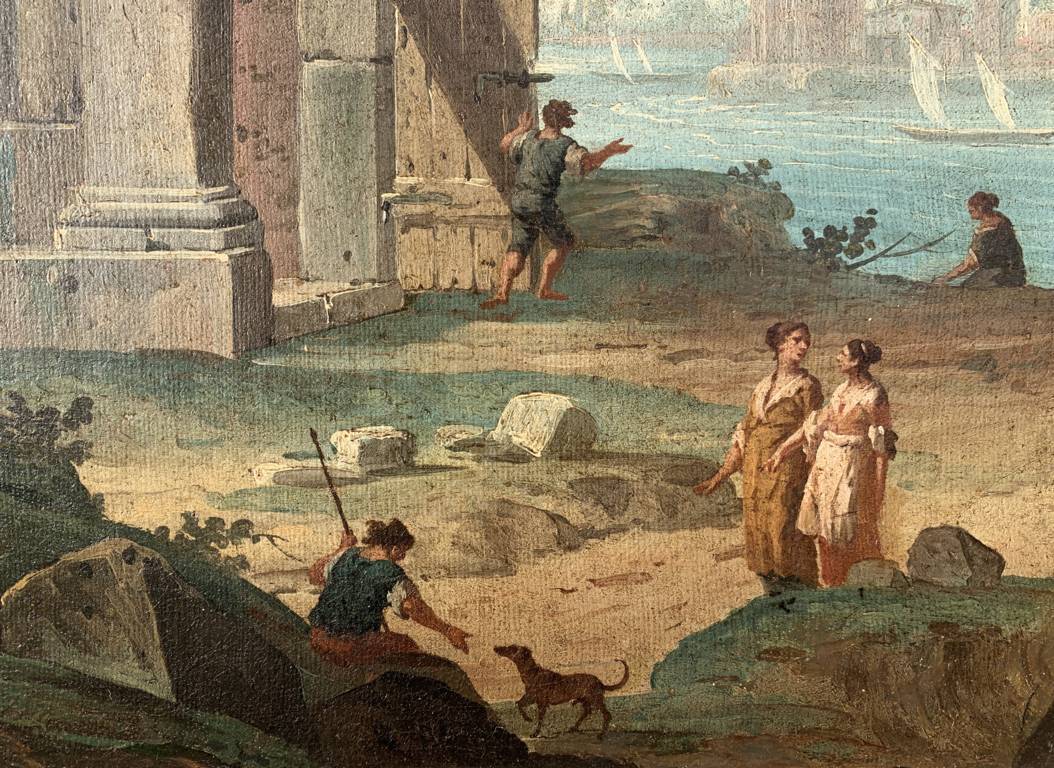
Antonio Joli (Modena 1700 – Naples 1777) – Architectural Capriccio with Ruins and Figures.
Ancient oil painting on canvas, in a carved wooden frame (not signed).
We thank Professor Dario Succi for confirming the attribution of this painting with a critical note.
Condition report: Lined canvas. The painted surface is in good condition.
Antonio Joli (Modena 1700 – Naples 1777) was an Italian painter and set designer, one of the most acclaimed exponents of European vedutism. Born in Modena, he moved to Rome in 1720 to perfect his technique at the school of Pannini, then moved to Venice in 1732, where he worked as a set designer and came into contact with artists such as Canaletto and Bernardo Bellotto. This mix of influences allowed him to stand out among the many landscape and architectural capriccio painters, giving his paintings an increasingly expansive sense of perspective, bathed in light.
His fame grew alongside his important commissions in London and the Spanish Court, where he was the first set designer for the Buen Retiro Theater. He returned to Venice in 1754, where he was among the founders of the Academy of Painting and Sculpture. He then spent his final years in Naples, where he was appointed chief set designer for the Real Teatro di San Carlo. He had also become a renowned view painter for the most prestigious patrons and noble travelers on the Grand Tour.
Our painting, rediscovered and authenticated by Prof. Dario Succi, dates back to Joli’s last period of activity, as evident affinities are shown by the scenographic paintings preserved in the collections of the royal palaces of Naples and Caserta dating back to 1776. It depicts a lively setting perfectly balanced between monumental ruins and characters in everyday poses, with a typical seascape in the background in shades of blue in symbiosis with the sky.


